
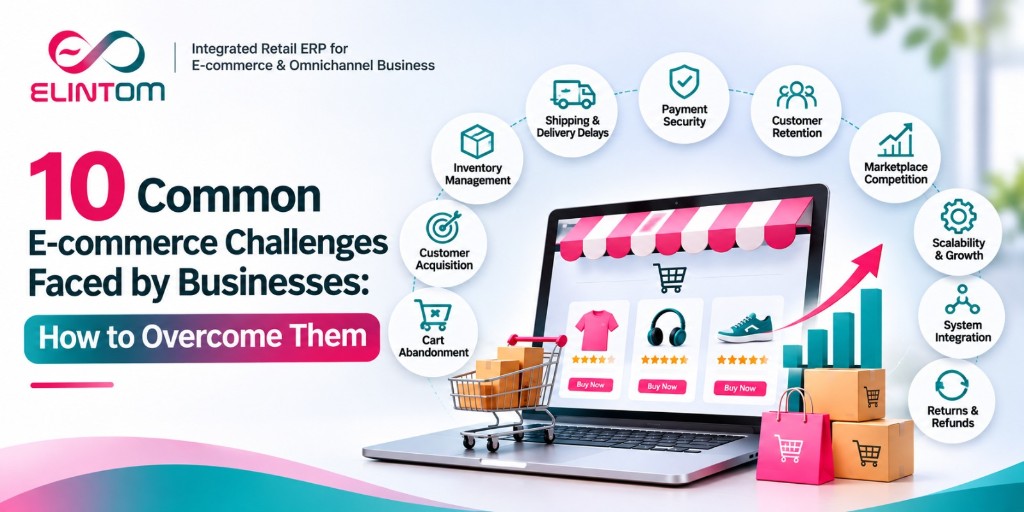
10 common ecommerce challenges and how to overcome them
10 Common E-commerce Challenges Faced by Businesses and How to Overcome Them
E-commerce has transformed the way businesses sell products, connect with customers and expand into new markets. From small online stores to established retail brands, businesses can now reach customers across different locations and sales channels.
However, running a successful e-commerce business involves much more than listing products and receiving orders. Every online purchase involves several interconnected activities including inventory management, order processing, payment handling, shipping, customer support and returns.
As businesses grow, managing these operations becomes increasingly challenging.
Selling across multiple platforms, maintaining accurate stock levels, attracting website visitors and converting them into customers require the right strategies and technology.
According to DHL’s 2026 E-Commerce Trends Report, based on research involving 29,000 online shoppers and 5,800 e-commerce businesses across 29 countries, customer expectations around delivery, payments, AI and shopping convenience continue to evolve. Source: DHL 2026 E-Commerce Trends Report.
So, what are the biggest challenges e-commerce businesses face today, and how can they overcome them?
1. Managing Inventory Across Multiple Sales Channels
One of the biggest challenges for growing e-commerce businesses is maintaining accurate inventory across different sales channels.
Businesses selling through Shopify, Amazon, their own websites and physical stores often struggle to keep stock information updated. When inventory is managed separately, the same product may appear available on multiple platforms even after it has been sold.
This can result in overselling, cancelled orders and disappointed customers.
How to overcome it:
Implement a centralised inventory management system that connects your sales channels. Automate stock updates whenever an order is placed, cancelled or returned.
Maintain accurate product information, monitor stock levels and establish reorder alerts to avoid running out of popular products.
2. Handling Orders from Multiple Platforms
As an online business expands, orders may come from several marketplaces, websites and social commerce platforms. Managing these orders separately can consume valuable time and increase the possibility of errors.
Teams may need to switch between different dashboards, manually update order statuses and coordinate with warehouse employees.
How to overcome it:
Adopt an integrated order management system that brings orders from supported sales channels into one workflow.
This helps businesses monitor incoming orders, track processing stages and coordinate fulfilment more efficiently.
Automating repetitive order-related tasks also reduces manual effort and allows employees to focus on customer experience and business growth.
3. Attracting Website Visitors and Converting Them into Customers
Driving traffic to an e-commerce website is only the first step. The bigger challenge is attracting the right audience and encouraging visitors to complete purchases.
Many businesses publish blogs, invest in social media marketing and run advertisements but struggle to generate consistent website traffic and enquiries.
How to overcome it:
Develop a well-planned digital marketing strategy that combines:
- SEO: Target relevant keywords and publish helpful, search-optimised content.
- Content marketing: Create blogs addressing common customer questions and industry challenges.
- Social media: Share product information, educational posts, customer stories and videos.
- Email marketing: Nurture potential customers through useful updates and offers.
- Paid advertising: Reach audiences actively searching for your products.
Use long-tail keywords, optimise blog headlines, build internal links and repurpose articles into social media posts, videos and infographics.
Track website traffic, search impressions, conversions and enquiries to understand which marketing activities deliver results.
4. High Shopping Cart Abandonment Rates
Getting customers to add products to their shopping carts does not guarantee a completed purchase.
Unexpected delivery charges, complicated checkout processes, limited payment options and unclear return policies can discourage customers from completing their orders.
DHL’s 2026 research found that 67% of online shoppers had abandoned a cart because of the delivery offering. This highlights how important delivery convenience and transparency are to purchase decisions. Source: DHL 2026 E-Commerce Trends Report.
How to overcome it:
Simplify the checkout process.
Display delivery charges clearly.
Provide multiple trusted payment options.
Offer transparent shipping and return policies.
Make the checkout experience mobile-friendly.
Use appropriate abandoned-cart email reminders.
A simple and transparent checkout experience can help businesses reduce unnecessary purchase barriers.
5. Delayed Shipping and Order Fulfilment
Customers expect their orders to arrive within the promised delivery period. Delayed dispatches, inaccurate delivery estimates and poor communication can negatively affect customer satisfaction.
These problems often occur when inventory, warehouse operations and order processing are not properly coordinated.
How to overcome it:
Improve coordination between inventory and fulfilment teams. Monitor order processing stages, maintain accurate stock information and work with reliable logistics partners.
Businesses should also communicate delivery timelines clearly and provide customers with order tracking updates.
Flexible delivery options and efficient warehouse processes can help improve the overall shopping experience.
6. Managing Product Returns and Refunds
Product returns are an unavoidable part of e-commerce. Customers may return products because of incorrect sizes, damaged items, product mismatches or changes in purchasing decisions.
Returns can create additional operational costs and affect inventory accuracy if they are not handled properly.
The National Retail Federation’s 2025 Retail Returns Landscape estimated that 19.3% of online sales would be returned in 2025. Source: NRF 2025 Retail Returns Landscape.
How to overcome it:
Establish a clear return and refund policy that customers can easily understand.
Maintain proper records of returned products, inspect items before updating available inventory and communicate refund progress.
Analyse return reasons regularly to identify recurring issues related to product descriptions, packaging, quality or delivery.
Accurate product images, detailed descriptions and sizing information can also help reduce avoidable returns.
7. Maintaining Consistent Product Information
Managing product details across multiple platforms can become complicated as the product catalogue grows.
Different product descriptions, prices, images, SKUs and stock quantities may appear across marketplaces and online stores. This creates confusion for customers and additional work for employees.
How to overcome it:
Maintain a centralised product catalogue with standardised product names, descriptions, pricing, images and SKU information.
Use suitable product management and integration tools to synchronise information across connected platforms.
Regular catalogue reviews can help businesses identify outdated listings, incorrect prices and inconsistent product details.
8. Managing Customer Expectations and Support
Customers expect quick and accurate responses to questions about product availability, order status, payments, delivery and returns.
When customer information is scattered across emails, messaging applications and different sales platforms, support teams may struggle to provide consistent assistance.
How to overcome it:
Centralise customer information and purchase history wherever possible.
Use CRM tools to organise customer interactions, automate routine notifications and maintain a record of enquiries.
Provide multiple support channels and establish clear response procedures.
AI-powered chat and virtual assistants can also help answer common questions and guide customers through routine processes, provided they offer accurate and useful assistance.
9. Understanding Business Performance Through Data
E-commerce businesses generate large amounts of information through website traffic, sales, inventory, advertising and customer interactions.
However, when this information is maintained in separate systems, understanding overall business performance becomes difficult.
Business owners may spend hours preparing spreadsheets and combining reports just to identify their best-selling products or most profitable sales channels.
How to overcome it:
Use integrated reporting and analytics tools to bring important business information together.
Monitor key performance indicators such as:
- Website traffic and conversion rates.
- Total sales and revenue.
- Best-selling and slow-moving products.
- Inventory turnover.
- Order fulfilment performance.
- Returns and cancellations.
- Marketing campaign performance.
- Customer acquisition costs.
Use these insights to identify opportunities, improve marketing performance and make informed business decisions.
10. Scaling an E-commerce Business Without Increasing Complexity
Growing an e-commerce business brings new opportunities, but expansion also introduces operational challenges.
More products, warehouses, employees and sales channels require better coordination. Processes that work for a small online store may become inefficient when order volumes increase.
Businesses that depend heavily on manual processes may struggle to maintain accuracy and service quality as they grow.
How to overcome it:
Invest in scalable technology and automate repetitive activities wherever possible.
Connect essential business operations, including inventory, order processing, POS, customer management and reporting.
Explore AI-powered tools where they provide genuine value, such as customer support, demand forecasting and operational analysis.
DHL’s 2026 research found that 38% of shoppers and 36% of businesses were already using AI-powered chat or virtual assistants in buying and selling activities. Source: DHL 2026 E-Commerce Trends Report.
Businesses should adopt automation thoughtfully, ensuring that technology improves efficiency without compromising customer trust.
How Can an Integrated Platform Simplify E-commerce Operations?
Most e-commerce challenges are interconnected. Inventory inaccuracies can cause order cancellations, delayed fulfilment can affect customer satisfaction, and disconnected reporting can make it difficult to identify operational problems.
This is why businesses need more than individual tools for every activity.
An integrated platform like ElintOm helps businesses connect essential retail and e-commerce operations through a unified system.
With ElintOm, businesses can streamline key activities such as:
- Inventory Management: Maintain better visibility of stock across connected stores, warehouses and sales channels.
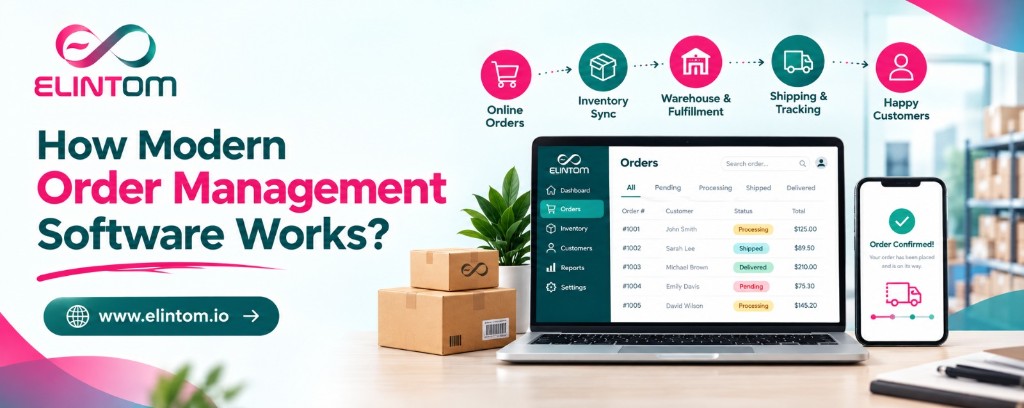
- Order Management: Manage orders from supported sales channels through a unified workflow.
- POS Integration: Connect physical store sales with inventory operations.
- CRM: Organise customer information and purchase history.
- E-commerce Integrations: Connect supported online stores and marketplaces.
- Business Reporting: Access relevant sales and operational information to support better decisions.
By connecting these business processes, ElintOm helps reduce disconnected workflows and supports more organised business operations.
Running a successful e-commerce business requires more than attracting customers and increasing sales. Businesses must also manage inventory accurately, process orders efficiently, provide reliable customer support and maintain visibility across their operations.
As online shopping continues to evolve, businesses that invest in SEO, content marketing, automation and integrated technology will be better prepared to respond to changing customer expectations.
The key is to identify operational challenges early and implement solutions that support both current requirements and future growth.
Whether you are managing a growing online store or selling across multiple marketplaces, the right technology can make everyday operations simpler and more manageable.
Ready to Simplify Your E-commerce Operations?
Bring your inventory, sales, orders and retail operations together with ElintOm.
Discover how an integrated platform can help your business improve operational visibility, streamline workflows and manage growth more efficiently.
Book a Free ElintOm Demo Today!
Visit: https://elintom.io/
References
- DHL eCommerce. (2026). 2026 E-Commerce Trends Report. Survey of 29,000 online shoppers and 5,800 e-commerce businesses. Read the report.
- National Retail Federation and Happy Returns. (2025). 2025 Retail Returns Landscape. Estimated 19.3% of online sales returned in 2025. Read the research summary.
- ElintOm. Inventory, POS, CRM and order management platform. Official platform page.
Frequently Asked Questions
Common challenges include managing inventory across sales channels, handling orders from multiple platforms, attracting and converting visitors, cart abandonment, delayed fulfilment, returns, inconsistent product information, customer support, disconnected reporting, and scaling without extra complexity.
Use a centralised inventory system that connects supported sales channels and automates stock updates when an order is placed, cancelled, or returned. Monitor stock levels and set reorder alerts for popular products.
Unexpected delivery charges, complicated checkout, limited payment options, and unclear return policies all discourage completion. DHL 2026 research found that 67% of online shoppers had abandoned a cart because of the delivery offering.
The National Retail Federation 2025 Retail Returns Landscape estimated that 19.3% of online sales would be returned in 2025.
An integrated platform connects inventory, orders, POS, CRM, supported ecommerce channels, and reporting so teams are not running each activity in a separate tool.
Bring orders from supported channels into one workflow, automate repetitive order tasks, keep product information in a central catalogue, and connect inventory with fulfilment so stock and delivery stay aligned.


Write a Comment
Join the omnichannel commerce discussion. Your email address will not be published.
Comment Submitted
Thank you! Your comment has been successfully received and is awaiting database admin moderation.
Form: Article Comment Form