
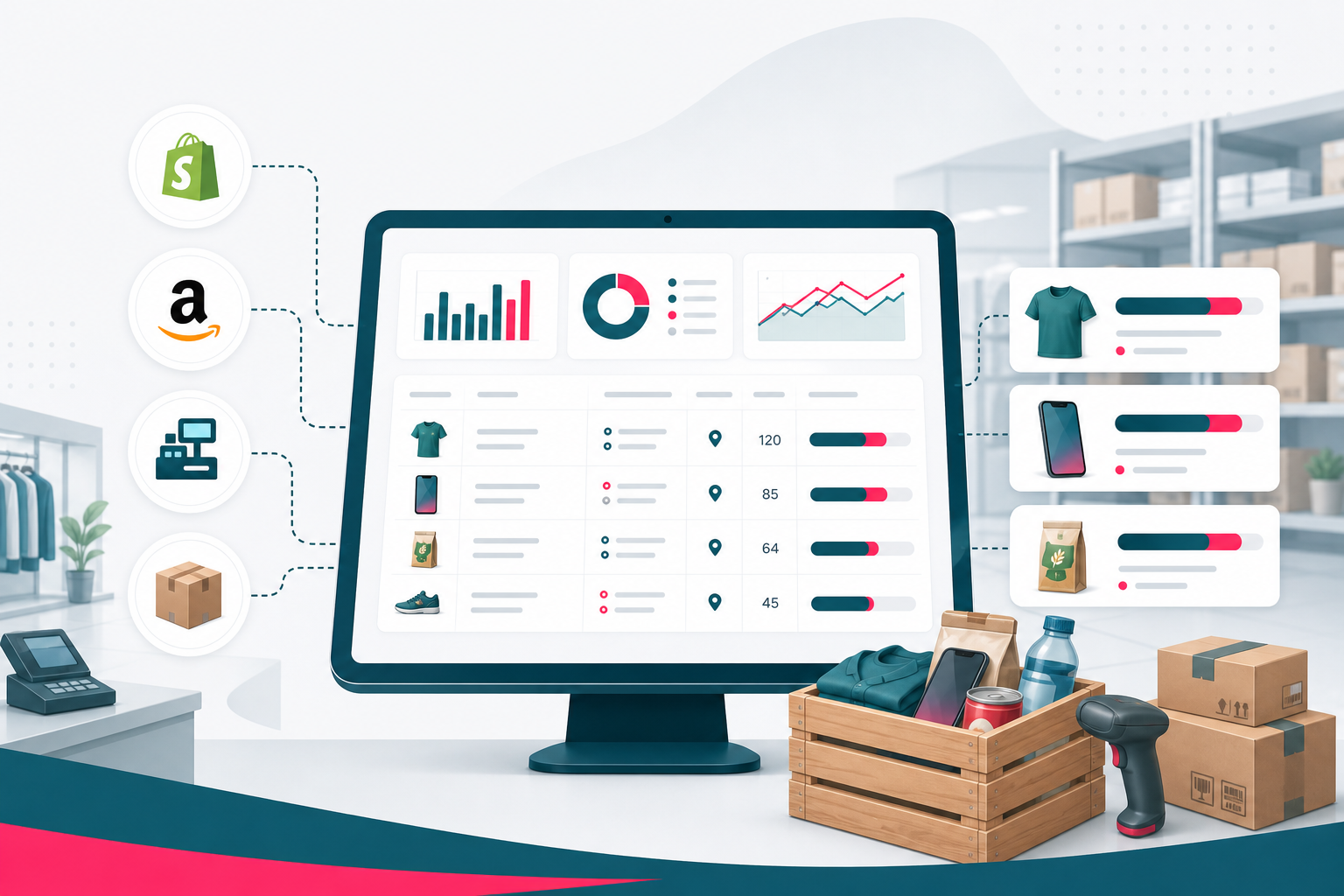
Inventory Management Software: The Complete Multichannel Retail Guide (2026)
Inventory management software is the system that tells every sales channel—your stores, Shopify storefront, Amazon listings, wholesale desk, and field reps—how much stock is actually safe to sell right now. Not how much sits on a warehouse shelf. Not what yesterday’s spreadsheet says. The number that prevents overselling, stockouts, and margin leaks across your entire retail operation.
If you sell through more than one channel, generic spreadsheets and channel-native inventory tools break quickly. Shopify does not know what your mall register just sold. Amazon FBA does not see store transfers. Your POS cannot pause Meta ads when size M runs out online. That is why multichannel retailers search for inventory management software in the first place—and why the category drives roughly 19,000–20,000 commercial-intent searches per month in the US alone, with related terms like inventory management system, retail inventory software, and multichannel inventory sync adding thousands more.
This guide is not another “top 10 tools” listicle. It is the operating model behind reliable stock: what to look for, how to implement it, and how platforms like ElintOm connect inventory, POS, orders, and marketplaces from one database—so your team stops firefighting oversells every Friday.
What inventory management software actually does (beyond counting boxes)
At its core, inventory management software tracks what you have, where it is, and what is committed to customers. Modern retail needs more than a digital ledger:
- Multi-location stock — Warehouse, back room, store floor, in-transit, FBA, 3PL, and consignment each hold different quantities of the same SKU
- Channel-aware publishing — Each marketplace or storefront may show a different available quantity based on buffers, exclusives, or velocity
- Reservation logic — Open orders, pick waves, BOPIS holds, and wholesale commitments reduce sellable stock before it ships
- Order orchestration — Sales on any channel deduct inventory and trigger fulfillment from the right location
- Replenishment signals — Reorder points, vendor lead times, and demand trends inform POs—not gut feel
- Financial alignment — COGS, margin by channel, and shrinkage reports tied to actual movement—not manual journal entries
Retailers who outgrow channel-specific tools usually discover the gap when available-to-sell (ATS) diverges from on-hand. Your warehouse shows 200 units; every channel still lists 200; but 140 are already spoken for. That is when overselling begins.
Why multichannel retail breaks without connected inventory software
Multichannel is not “we also have a website.” It is one commercial operation with many customer entry points. Without unified inventory management software, these failure modes appear in every vertical:
1. Overselling and cancellation penalties
A dress sells in-store while Amazon still shows two units. The marketplace order gets accepted, then cancelled. Account health scores drop. Customer trust erodes faster than ad spend can replace it.
2. Phantom stock (the opposite problem)
Channels hide inventory because buffers were set too high or sync jobs failed silently. Revenue sits on the table while competitors capture the click.
3. Manual reconciliation tax
Ops teams export CSVs from Shopify, Square, and warehouse WMS into Excel every night. One typo becomes a week of explaining variances to finance.
4. Marketing that ignores reality
Email campaigns and paid social promote SKUs that sold out hours ago. ROAS looks fine until refund rates spike.
5. Expansion paralysis
Opening store #4 or listing on a second marketplace feels risky because nobody trusts the stock number. Growth stalls—not from lack of demand, but lack of data integrity.
The fix is not “more discipline.” It is a single stock authority with rules every channel reads from—exactly what purpose-built retail inventory management software provides.
The ATS operating model: how serious retailers calculate sellable stock
Most ranking articles skip this layer. It is also where implementations succeed or fail. Treat this formula as your north star:
Available-to-sell (per channel) = eligible on-hand − open reservations − blocked stock − channel buffer − transfer risk
On-hand vs available-to-sell
On-hand is physical count. Available-to-sell is what you promise customers. Every channel should publish ATS, never raw warehouse totals.
Reservations that must sync in real time
- Pending ecommerce and marketplace orders not yet picked
- Buy online, pick up in store (BOPIS) holds
- Wholesale or B2B allocations
- Customer service holds and quarantine (damaged, QC)
Channel buffers (dynamic, not fixed)
Fast-moving SKUs on Amazon may need a higher safety buffer than your owned Shopify store. Fashion sizes need size-level buffers, not style-level guesses. Fixed “keep 5 units back” rules either strand inventory or still allow oversells during peaks.
Global pool vs channel allocation (false choice)
A global pool maximizes visibility but increases oversell risk if reservations lag. Fixed allocations per channel reduce risk but strand stock in the wrong place. The stronger approach is channel-aware pooling: one source of truth, channel-specific publish rules, shared reservation engine.
ElintOm implements this model across apparel, electronics, grocery, and QSR operations—where recipe-level deduction matters as much as SKU counts.
15 features to demand from inventory management software in 2026
Use this as a vendor scorecard. Weight features by your pain—overselling usually means reservations + sync latency matter most.
- Real-time sync — Sub-minute updates to Shopify, WooCommerce, Amazon, Noon, and POS—not nightly batch jobs
- Multi-warehouse / multi-store — Location-level permissions, transfers, and fulfillment routing
- ATS publishing — Channel-specific sellable quantities with configurable buffers
- Unified order queue — All channels in one fulfillment board with status, priority, and SLA
- POS integration — Store sales deduct the same pool online marketplaces read from
- Marketplace connectors — Amazon, eBay, Flipkart, Noon, Etsy as native integrations—not brittle middleware
- Barcode / RFID support — Receiving, picking, and cycle counts that update the system of record
- Purchase orders & vendor management — Lead times feed replenishment suggestions
- Kitting, bundles, and variants — Size/color matrices without manual duplication
- Returns & BORIS — Buy online, return in store updates stock and customer history correctly
- CRM linkage — Customer profiles see purchases across channels
- Role-based access — Store managers see their branch; HQ sees the network
- Reporting & margin by channel — Revenue minus true COGS and fulfillment cost
- API-first architecture — Connect ERP, accounting, and custom tools without rip-and-replace
- Audit trail — Who changed stock, when, and why—essential for shrink investigations
How to choose inventory management software (decision framework)
Skip vanity demos. Run vendors through four gates:
Gate 1: Channel fit
List every place you sell today and in 18 months. If a vendor cannot show live sync for those channels—not roadmap slides—drop them.
Gate 2: Reservation test
During the pilot, place simultaneous test orders on two channels for the last unit of a SKU. Only one should succeed; both channels should show zero ATS within seconds.
Gate 3: Location complexity
Single warehouse brands need simpler tools. Multi-store retailers, FBA + own warehouse, or franchise networks need location-aware routing on day one.
Gate 4: Total cost of ownership
Include implementation, training, connector fees, and the hidden cost of your team’s manual hours. Cheap software that leaves ops in Excel is expensive.
| If your priority is… | Optimise for… | De-prioritise… |
|---|---|---|
| Stopping oversells | Real-time ATS, reservations, sync logs | Cosmetic dashboards |
| Opening stores | Multi-location POS + transfers | Single-warehouse WMS depth |
| Marketplace growth | Amazon/Noon/Flipkart connectors, listing sync | Generic CRM modules |
| Margin visibility | Channel COGS, returns, shrink reporting | Social posting tools bundled in |
90-day rollout plan for multichannel inventory software
Most failed projects try to connect everything on day one. This sequence works for mid-size retail and DTC brands:
Days 1–14: Foundation
- Audit SKUs—merge duplicates, fix UPC/GTIN gaps, document kits and bundles
- Map locations and who owns each stock count
- Define ATS rules per channel (buffers, exclusives, max publish caps)
- Clean opening balances with a physical count—not book numbers alone
Days 15–45: Connect core channels
- Integrate primary ecommerce (Shopify/WooCommerce) + main POS
- Run shadow mode: new system tracks alongside old tools, compare daily
- Fix sync exceptions before cutover
Days 46–75: Marketplaces & automation
- Add Amazon/marketplace feeds with stricter buffers initially
- Enable low-stock alerts, reorder suggestions, and cart/inventory-aware marketing rules
- Train store managers on BOPIS and returns workflows
Days 76–90: Optimise
- Tighten buffers using sell-through data
- Review margin by channel; pause unprofitable listings
- Document SOPs—inventory software only works if Monday behaves like Friday
Inventory management software vs spreadsheets vs channel-native tools
Spreadsheets fail at reservations, concurrent edits, and real-time publishing. They are fine for 50 SKUs and one channel; they become operational debt at multichannel scale.
Channel-native inventory (Shopify inventory, Amazon FBA reports, POS stock) each optimises for its silo. None is the system of record for the whole business.
Inventory management software sits as the stock authority above channels—pushing ATS outward, pulling orders inward, feeding finance and marketing with one truth.
That is the architecture ElintOm’s platform is built around: not replacing every tool, but connecting them so inventory, orders, CRM, and analytics share one database.
Industry snapshots: what changes by vertical
Apparel & fashion
Size/colour matrices, seasonal drops, and high return rates demand variant-level ATS and BORIS. Fashion retailers lose the most margin to size oversells on marketplaces.
Electronics & appliances
Serial numbers, warranty registration, and supplier lead times matter. Buffer rules often tie to supplier SLA, not generic percentages.
Restaurants & QSR
Recipe-level deduction connects menu sales on aggregators and POS to ingredient stock—see our Zomato & Swiggy integration guide for India-specific workflows.
UAE & GCC retail
VAT billing, multi-mall footprints, and marketplace-heavy ecommerce (Noon, Amazon.ae) require local compliance plus multichannel sync—covered in our UAE ecommerce management guide.
The ROI case: what poor inventory actually costs
Finance teams often underestimate soft costs. Use these benchmarks in internal business cases:
- Oversell cancellations — Marketplace penalty fees + lost lifetime value of affected customers
- Stockouts on hero SKUs — Direct lost revenue; paid ads sending traffic to dead listings
- Overstock write-downs — Capital tied in slow movers that could fund growth SKUs
- Labour hours — Manual reconciliation at 5–15 hours/week for mid-size ops teams
- Shrink and fraud — Without audit trails, investigations stall at “we think the count is wrong”
Retailers who connect inventory software to marketing automation often see the fastest payback: ads and emails pause when ATS hits zero, protecting ROAS without manual babysitting.
Keyword cluster this guide targets (for your SEO team)
Primary: inventory management software (~19K–20K/mo US commercial searches). Secondary terms woven throughout: multichannel inventory management, retail inventory management software, inventory management system for ecommerce, POS inventory sync, Shopify Amazon inventory sync, available to sell inventory, omnichannel inventory management software.
Ranking top 10 for the head term alone takes authority and backlinks—plan 3–6 months with internal links from your blog cluster and consistent Search Console monitoring. Long-tail variants in this article often rank faster and compound traffic toward the pillar.
Frequently asked questions
What is inventory management software?
Software that tracks stock across locations and sales channels, calculates available-to-sell quantities, reserves inventory for open orders, and syncs those numbers to ecommerce, marketplaces, and POS systems in near real time.
How is inventory management software different from a WMS?
Warehouse management systems optimise pick/pack/ship inside a building. Inventory management software governs what every customer-facing channel is allowed to sell—often integrating with a WMS rather than replacing it.
What is the best inventory management software for small retail?
The best fit depends on channel count. Single-store, single-site brands may start with POS-native stock. Once you add Shopify plus Amazon—or a second store—you need reservations and ATS publishing, not spreadsheets.
How does inventory management software prevent overselling?
It maintains one reservation ledger. When an order is placed on any channel, ATS drops everywhere before payment clears. When stock hits zero, channels stop accepting orders or auto-pause listings.
Can inventory software connect Shopify and Amazon?
Yes. Modern platforms sync listings and stock bidirectionally, with channel-specific buffers so FBA and FBM rules coexist with your owned store.
Do I need inventory management software if I have ERP?
ERP handles finance and manufacturing well; many lack real-time marketplace sync and ATS logic. Often ElintOm layers on top of ERP via API—connecting channels without replacing the ledger of record.
What is available-to-sell (ATS) inventory?
The quantity you publish to a sales channel after subtracting reservations, holds, buffers, and unavailable stock from physical on-hand counts.
How long does implementation take?
Single-location ecommerce + POS: often 4–8 weeks. Multi-store or multi-marketplace: 8–12 weeks with proper data cleanup and shadow testing.
How much does inventory management software cost?
Pricing varies by locations, SKUs, connectors, and users. Evaluate total cost including implementation and reduced manual labour—not licence price alone.
Does ElintOm include POS and CRM?
Yes. ElintOm is an omnichannel platform—inventory, order management, POS, CRM, and marketing automation share one database so stock and customer data stay aligned.
Is cloud inventory software secure?
Reputable vendors use encrypted transport, role-based access, and audit logs. Ask about SOC 2 or equivalent compliance if you handle high-volume consumer data.
What metrics should I track after go-live?
Oversell rate, stockout rate on top 20% SKUs, inventory accuracy (cycle count variance), days of supply, and margin by channel—review weekly for the first quarter.
Next step: Book an ElintOm demo and we will map your channels, locations, and ATS rules—or contact our team with your current stack (Shopify, Amazon, POS, ERP) and we will outline a practical integration path.



Write a Comment
Join the omnichannel commerce discussion. Your email address will not be published.
Comment Submitted
Thank you! Your comment has been successfully received and is awaiting database admin moderation.
Form: Article Comment Form