
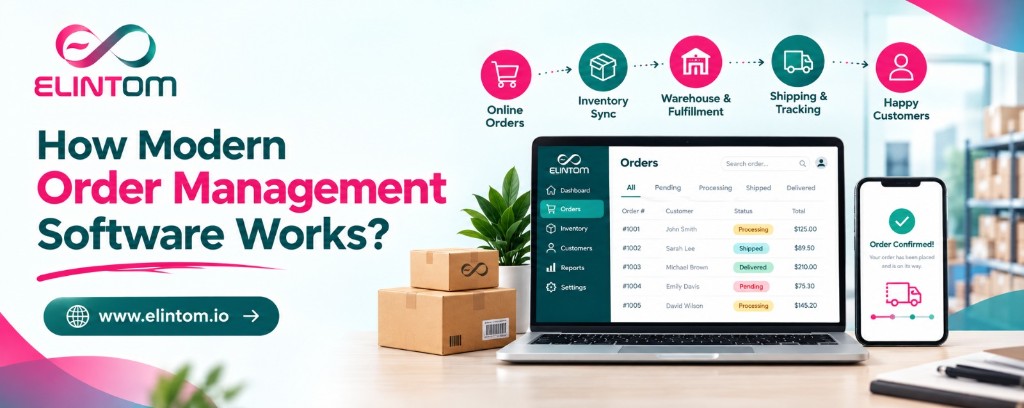
How modern order management software coordinates online orders, inventory, warehouse fulfillment, shipping and customer confirmation.
How Modern Order Management Software Works?
Why make order management complex while selling through physical stores, e-commerce websites, and online marketplaces? Many businesses are getting stuck while operating each channels separately from stock discrepancies, delayed processing, duplicate work, and limited visibility into order status.
Modern order management software helps businesses coordinate these activities through a centralized system. It connects order processing with inventory visibility, sales channels, fulfillment workflows, and business reporting.
For retailers, wholesalers, and growing e-commerce businesses, the objective is simple: process orders accurately, maintain better control over inventory, and provide a consistent customer experience.
Recent industry research also shows why these capabilities matter. Let’s explore what modern order management software looks like, the latest trends shaping it, and what businesses should consider when choosing a solution.
What Does Modern Order Management Software Look Like?
Modern order management software is more than a digital register for recording sales. It provides a centralized view of orders and helps teams coordinate the activities required to fulfill them.
Depending on the platform, its dashboard may display:
- Order status: New, processing, dispatched, completed, cancelled, or returned orders.
- Inventory availability: Stock quantities across stores and warehouses.
- Sales channels: Orders received through websites, physical stores, and connected marketplaces.
- Fulfillment workflows: Picking, packing, dispatch, and delivery progress.
- Customer information: Order history and relevant customer records.
- Reports and analytics: Order volumes, sales performance, outstanding orders, and operational trends.
For example, when a customer places an order online, an integrated system can record the order, check available inventory, and direct the fulfillment process according to configured rules. If the system also connects to the POS and other sales channels, it can help maintain consistent inventory records across those channels.
Why Modern Order Management Matters
Research published by the MIT Center for Transportation & Logistics in April 2026 highlights the increasing complexity of omnichannel operations.
The 2026 State of Supply Chain Omnichannel Report, based on a survey of 647 supply-chain professionals, found that:
- 81% of respondents reported ongoing e-commerce growth.
- 60% were implementing omnichannel distribution strategies, an increase of 10 percentage points year over year.
- 51% identified channel integration as a leading strategic challenge.
- 53% reported challenges involving inventory positioning, demand planning, and logistics costs.
The research also highlights the growing use of AI in demand forecasting, warehouse operations, inventory management, and fulfillment. These findings suggest that businesses need better coordination between their sales channels and operational systems as e-commerce expands.
Source: MIT Center for Transportation & Logistics — 2026 Omnichannel Supply Chain Research.
For businesses evaluating order management software, the practical takeaway is to prioritize integration, inventory visibility, fulfillment efficiency, and reliable operational data rather than focusing only on order entry.
7 Essential Features of Modern Order Management Software
1. Centralized Order Processing
A centralized order management system brings orders into a common workspace. Teams can review incoming orders, check their status, and coordinate processing without constantly switching between disconnected tools.
This is particularly useful for businesses handling orders from several sales channels.
2. Inventory Visibility Across Locations
Accurate inventory information helps teams understand whether products are available before accepting or fulfilling an order.
When order management integrates with inventory management software and POS systems, stock movements can be reflected across connected channels. This helps businesses reduce stock discrepancies and the risk of accepting orders for unavailable products.
3. Omnichannel Order Management
Customers may purchase through a retail store, an online shop, or a marketplace. Modern omnichannel order management software helps businesses coordinate these different sources.
Depending on the system, businesses can consolidate orders, apply fulfillment rules, and maintain a unified view of sales activity.
4. Automated Order Workflows
Automation can reduce repetitive tasks such as order routing, status notifications, and workflow updates.
For example, a configured rule may direct an order to a store or warehouse with sufficient stock. Staff can then follow the relevant picking, packing, and dispatch procedures.
Automation should be evaluated carefully to ensure that rules reflect actual business requirements.
5. Fulfillment and Delivery Tracking
Order management does not end when a customer places an order. Businesses also need to monitor preparation, dispatch, delivery, and exceptions.
Depending on available integrations, modern software can help teams coordinate fulfillment locations, connect shipping workflows, and provide customers with relevant order updates.
6. Reporting and Business Analytics
Order reports help managers understand order volumes, pending transactions, processing delays, and sales trends.
When order information is connected with inventory and sales data, businesses can make more informed decisions about stock replenishment, staffing, and operational priorities.
7. AI-Assisted Planning and Decision-Making
AI is becoming increasingly relevant to supply-chain operations. The MIT 2026 research identifies applications across demand forecasting, warehouse management, inventory management, and transportation and fulfillment.
In order management, AI-enabled capabilities may support demand prediction, exception identification, and inventory allocation. However, not every order management system includes these features, and their value depends on data quality and implementation.
Businesses should distinguish between established software capabilities and emerging AI features when evaluating vendors.
Benefits for Retailers and Wholesalers
The right order management software can help businesses:
- Improve operational efficiency: Centralized order information reduces the need to check multiple systems.
- Reduce inventory discrepancies: Integration between sales and inventory systems helps maintain more consistent stock records.
- Improve order visibility: Teams can identify pending orders and follow their progress more easily.
- Support business growth: Connected workflows can make it easier to manage additional stores, sales channels, and order volumes.
- Strengthen customer service: Accurate order information helps staff respond to customer enquiries more effectively.
These benefits depend on implementation quality, staff training, process design, and the software’s actual capabilities.
How ElintOm Supports Connected Order Management
ElintOm is a cloud-based business management platform that connects retail operations, POS, inventory, e-commerce, and related workflows.
According to its official order management software page, ElintOm provides a unified order queue for connected store, Shopify, Amazon, and website orders. The page also describes fulfillment routing to suitable stores or warehouses and inventory updates after fulfillment.
These capabilities are relevant to businesses that want to reduce the operational complexity of managing orders across different channels. ElintOm is a customized software platform.
Businesses exploring ElintOm should evaluate how its available integrations, order workflows, inventory controls, and reporting features fit their specific requirements.
Explore the ElintOm platform or visit the ElintOm Order Management page to learn more.
How to Choose the Right Order Management Software
Before investing in a solution, consider these factors:
- Integration: Does it connect with your existing POS, inventory, e-commerce, and accounting systems?
- Scalability: Can it support additional products, stores, and sales channels?
- Inventory accuracy: How are stock updates handled across connected systems?
- Automation: Can workflows be configured to match your business processes?
- Reporting: Does it provide useful insights into orders, sales, and fulfillment?
- Implementation: What are the setup, migration, training, and support requirements?
- Security: Does it offer appropriate access controls and data protection?
The right solution should address current operational challenges while supporting future business needs.
Modern order management software helps businesses coordinate orders, inventory, sales channels, and fulfillment through connected workflows. As recent MIT research highlights, growing e-commerce activity and omnichannel complexity are making integration and operational visibility increasingly important.
Businesses should look beyond basic order entry and assess inventory accuracy, automation, reporting, integrations, and scalability when choosing a solution.
With its connected retail, POS, inventory, and order management capabilities, ElintOm is an option for businesses exploring a more unified approach to retail operations.
Ready to simplify your order management? Visit ElintOm and book a personalized demo to explore how its platform may fit your business needs.
References
- MIT Center for Transportation & Logistics. (2026, April 16). AI Is “Not Optional Anymore” in Omnichannel Supply Chains, New MIT CTL Research Finds. Read the research summary.
- MIT Omnichannel Supply Chain Lab. Research on omnichannel fulfillment, supply chains, and AI. Explore the research.
- Forrester. (2026, May 7). Order Management System (OMS) Shifts in Adoption, 2026. View the report.
- ElintOm. Order Management Software: From Warehouse to Delivery. Official product page.
- ElintOm. Retail ERP, POS and CRM Platform. Official platform page.
Frequently Asked Questions
It is software that helps businesses record, process, track and fulfill customer orders across supported sales channels.
An order management system receives an order from a connected sales channel, checks stock availability, allocates fulfillment to a store or warehouse using configured rules, then records picking, packing, dispatch, status updates, returns and reporting.
Order management software focuses on capturing, routing and fulfilling customer orders. ERP software covers a broader set of business operations such as inventory, purchasing, finance and reporting. Many retailers use an OMS as part of a connected ERP platform rather than as a standalone order-entry tool.
Inventory management software tracks stock quantities, locations and movements. Order management software uses that inventory data to accept, allocate and fulfill orders. The two work best when they share one stock ledger.
Depending on the system and its integrations, order management software can connect POS, websites and marketplaces so orders and stock updates stay in one workflow. Confirm the exact connectors for your stack before rollout.
Retailers should assess integration with POS, inventory, e-commerce and accounting; inventory accuracy across locations; configurable automation; reporting; implementation and training; security; and whether the software can scale with additional stores and channels.
Some platforms include AI-assisted demand prediction, exception identification and inventory allocation. Not every order management system includes these features, and their value depends on data quality and implementation.
ElintOm is a cloud-based business management platform that connects retail operations, POS, inventory, e-commerce and related workflows. Its order management page describes a unified order queue, fulfillment routing to stores or warehouses, and inventory updates after fulfillment. Evaluate the available integrations against your requirements.



Write a Comment
Join the omnichannel commerce discussion. Your email address will not be published.
Comment Submitted
Thank you! Your comment has been successfully received and is awaiting database admin moderation.
Form: Article Comment Form